The utter madness of how conservation charities support wildlife-killers against the living planet.
By George Monbiot, published in the Guardian 25th November 2026
Drumroll please. I am about to unveil the species of fish that’s best to eat if you want to protect the living seas. Ta-dah! It’s … I hope that clears things up. Unfortunately, over the past few years, a noisy industry has developed to tell you otherwise. You’re doing the planet a favour if you eat mackerel, sorry, cod, I mean haddock, no coley, make that pollack – oh, whoops! These choices might make you feel better about yourself. But they do nothing but harm to marine wildlife. The fish you should choose is none of the above.
Cause, could I introduce you to effect? In April, the Marine Conservation Society, through its Good Fish Guide, suggested you stop eating cod and eat hake instead. Six months later, it lamented that hake is now overexploited thanks to “increased fishing pressure”, and downgraded its sustainability ratings. How on earth did that happen? Beats me.
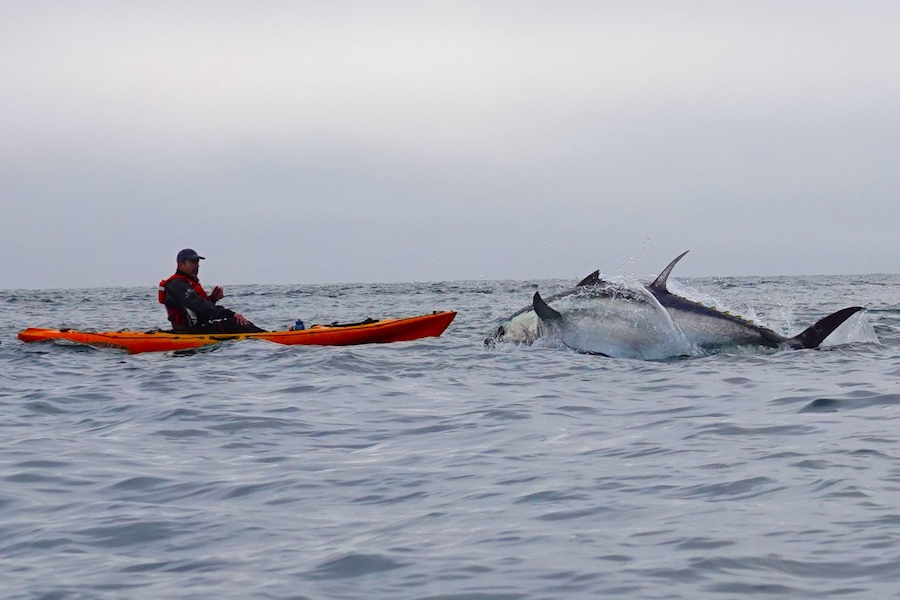
The society now gives bluefin tuna caught in the UK a green rating, which means the “most sustainable seafood option”: let the killing continue. Yet, as the government told me last year, “there are no estimates of the number of bluefin tuna in UK waters”. As a leading marine conservation charity notes, “it’s not yet clear if populations have reached sustainable levels that can withstand increases in commercial fishing pressure”. Which charity? Ah yes, the Marine Conservation Society. We also know that very large animals are especially vulnerable to population collapse and extinction. How did a “conservation” charity end up advising us to eat marine megafauna? What next? Eco-friendly whale meat?
Another group, the Marine Stewardship Council, slaps its happy fish logo on your packet of fish fingers, and you feel like a good person, which doubtless you’re trying to be. A little while later, you discover that your fish-friendly fish turns out, astonishingly, to be unfriendly to fish. Who knew?
Earlier this month, the council recertified Antarctic krill as sustainable, despite the fact that, once again, we know far too little about the likely impact of the industry, while the major fishers refuse to make fundamental concessions to lessen that impact. Krill underpin the entire Southern Ocean ecosystem, feeding the great whales whose numbers had at last begun to recover, as well as seals, penguins and other seabirds. The giant fishing ships operate among the major whale pods, and compete directly with them for prey. A fishery that could take down everything gets the blue tick of approval.
Macmillan Cancer Support doesn’t certify lung-friendly cigarette smoking. Age UK doesn’t advocate slaughtering elderly people. Why do our conservation and animal welfare groups (the RSPCA with its “assured” labels on slaughtered livestock is another astonishing example) so often side with the killers against the creatures they were founded to defend?
In the 19th century, the fishing industry claimed that ploughing the seabed made it more productive. Now we know that the seabed in many places was once as rich and complex and multi-storied as a rainforest, and that dragging trawl nets or scallop dredges across it, as has happened almost everywhere, smashes this delicate system, which can take centuries to recover.
But it’s as if the old myth persists. Perhaps this is why bottom trawlers are still allowed into marine protected areas, and why Greenpeace is left to do the job of the government, by dropping boulders on the seabed to try to stop them. But guess what? Fish caught in these “protected” places get the same sustainability rankings as fish caught outside them.
There are plenty of organisations trying to reconcile marine protection with the demands of the fishing industry. But where are the major groups campaigning for an end to commercial fishing? It’s never going to be good for the ecosystem, however it’s done, just as tobacco is never going to be good for your health. And surely, whatever we’re seeking to achieve, we should bargain high?
Instead, we must make do with calls to tweak the killing industry. Of these, the new report by Oceana is a useful guide to just how bad things have got. What it shows, broadly speaking, is that the bigger the boat, the bigger the problem. Inspections at sea of fishing vessels over 12 metres long found them breaking the rules 66% of the time, while smaller boats, under 10 metres, did so just 10% of the time.
The infractions are devastating. Oceana’s report shows that in 2025, an estimated 100,000 tonnes of fish from UK quota stocks, much of it saleable, were dumped dead or dying overboard. Why? Because once you’ve caught your quota of one species, you have to stop fishing. So if you’re targeting a more valuable one, you dump the first fish and carry on. The truth goes overboard. At least 80% of the plaice caught between 2023 and 2025 in the Irish Sea were dumped, which could be why their population is now classified as “critically low”.
This practice could be stopped almost immediately if governments insisted that every boat carries remote monitoring equipment, which is extremely cheap and makes enforcement very easy. But despite conservation groups demanding this for many years, all the UK governments still mostly side with the law-breakersagainst more responsible fishers. Why?
Oceana discovered that in the 2024-25 financial year, only 1.5% of the infringements discovered by inspections at sea resulted in a financial penalty. The total value of the fines imposed was £28,000: probably less than a single large boat makes just once by breaking the rules. Most law-breakers got “verbal advice”. That’ll learn ‘em.
Worse still, we’re paying for it. The biggest boats – which are the most likely to break the rules – also get the biggest fuel tax subsidies. Between 2012 and 2022, Oceana shows, an average of 27 fishing ships over 40 metres long harvested £230m in these subsidies, or £8.5m per vessel. The more damaging they are, the bigger the benefit: bottom trawlers use the most fuel, so they get the biggest subsidy. Owners of the large boats tend to be extremely hard to identify, as they often hide behind a network of shell companies. But they’re likely to be very rich. Last year the five companies with the biggest fishing quotas made combined profits of £125m. Why are we helping them to plunder our seas?
None of this seems to land, partly because we’re simultaneously being assured that by continuing to eat fish – including fish caught by subsidised, rule-breaking trawlers smashing up protected areas – we’re doing the world a favour. Why do some “nature defenders” seem to prioritise the fishing industry over the recovery of broken ecosystems? They too have become lost at sea.
www.monbiot.com